Practical Resources for Mission-Driven Leaders
Running a nonprofit is hard enough. These free resources are designed to help you solve real problems, ask better questions, and lead with greater clarity and confidence.
Grants Ready Metrics Guide
Great grant proposals don't begin with writing—they begin with collecting the right evidence. In this free guide, you'll discover the 10 essential metrics that funders look for when evaluating nonprofit organizations, along with practical strategies for tracking each one without expensive software or a dedicated evaluation team. You'll learn how to measure your program's reach, demonstrate meaningful outcomes, communicate organizational efficiency, and showcase the broader impact of your work in ways that resonate with grantmakers.
Whether you're applying for your first grant, strengthening your annual reports, or building a culture of evidence within your organization, this guide provides an accessible roadmap for transforming everyday program data into compelling proof of impact. By the end, you'll know exactly which numbers to start tracking today and how those metrics can help your nonprofit secure more funding, build greater credibility, and tell a stronger story about the difference you're making.


What Funders Really Want to Know
Every nonprofit leader believes their work is making a difference. The real question is whether you can demonstrate that difference with confidence. This free ebook explores what funders are truly looking for when they ask for outcomes, evidence, and impact—and why strong program evaluation is about far more than checking reporting boxes. You'll learn how to move beyond counting activities and begin measuring meaningful change that builds credibility with funders, boards, donors, and community partners.
Inside, you'll discover how to distinguish activities from outcomes, collect evidence that actually answers important questions, and communicate your results in ways that are both compelling and credible. Rather than overwhelming you with technical research methods, this guide provides practical, accessible strategies for building an evaluation system that strengthens decision-making, improves programs, and helps your organization tell a more powerful story. If you've ever struggled to explain your impact beyond anecdotes or basic statistics, this resource will give you a clear roadmap for turning data into confidence—and confidence into support.
Strategic Planning Readiness Checklist
A successful strategic plan doesn't begin with a retreat—it begins with asking the right questions. This practical checklist helps nonprofit leaders assess whether they're truly ready for strategic planning by examining leadership alignment, stakeholder engagement, organizational data, finances, governance, and implementation capacity. In less than 15 minutes, you'll identify your organization's strengths, uncover potential blind spots, and gain a clearer understanding of what needs attention before investing time and resources into a new strategic plan.
Whether you're preparing for your first strategic planning process or refreshing an existing plan, this checklist will help ensure your next planning effort leads to meaningful action instead of another document that sits on a shelf.

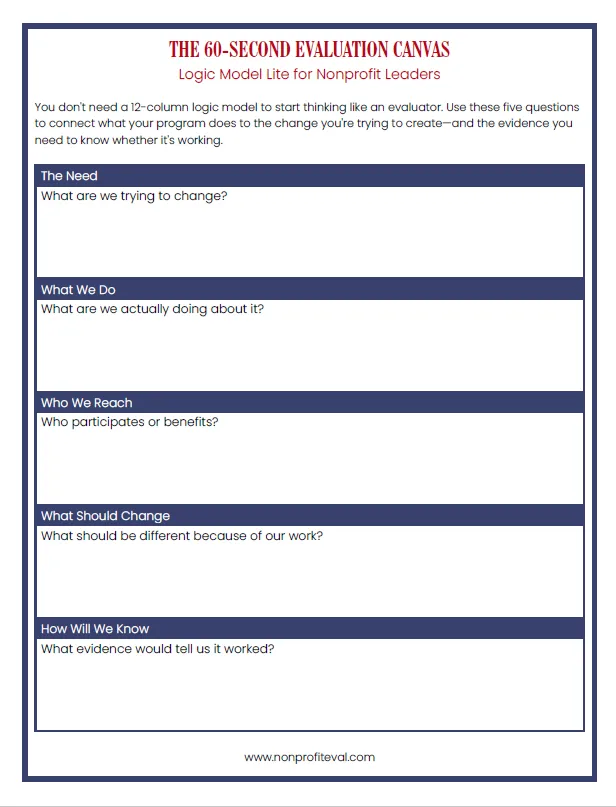
60-Second Evaluation Canvas: Logic Model Lite
Program evaluation doesn’t have to begin with a complicated logic model. The 60-Second Evaluation Canvas helps nonprofit leaders quickly connect what their program does to who it serves, the change they hope to create, and the evidence they need to know whether it’s working.
Use this one-page tool to clarify your program’s purpose, identify meaningful outcomes, and start thinking about evaluation in a practical, decision-focused way. Whether you’re designing a new program or taking a fresh look at an existing one, the canvas gives you a simple place to start.
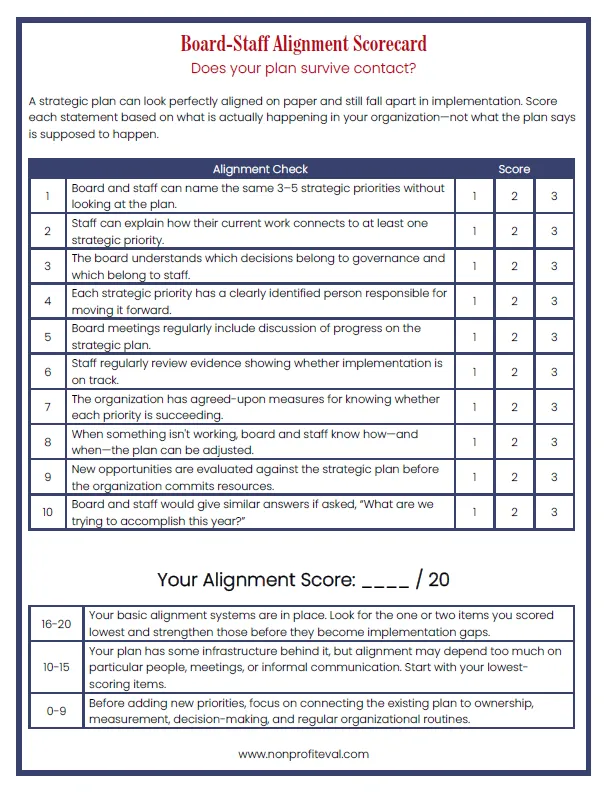
Board–Staff Alignment Scorecard
A strategic plan can look perfectly aligned on paper and still fall apart during implementation. The Board–Staff Alignment Scorecard helps you identify whether your board and staff actually share an understanding of your organization’s priorities, responsibilities, measures of success, and approach to implementation.
Complete the 10-question scorecard to uncover potential alignment gaps and identify where stronger communication, ownership, or organizational systems may be needed. It’s a quick way to find the places where your strategy may be getting lost between the boardroom and the day-to-day work.
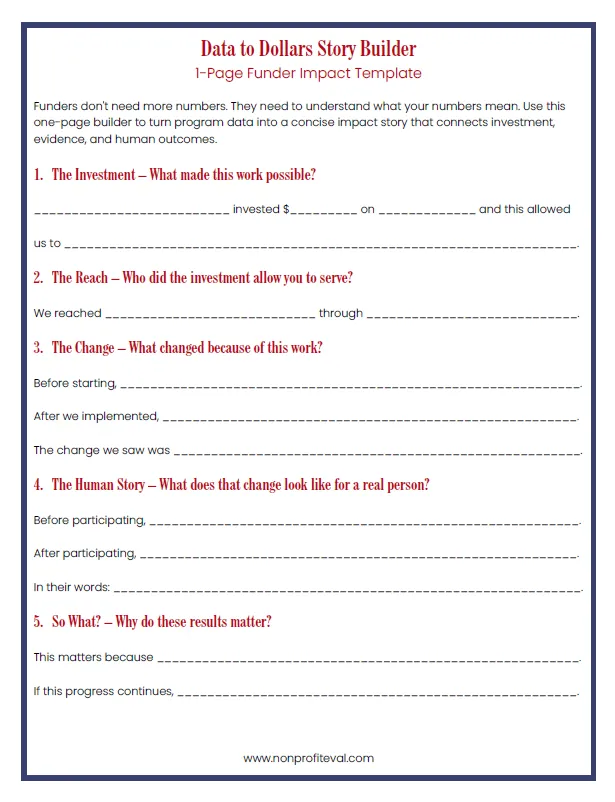
Data to Dollars Story Builder: 1-Page Funder Impact Template
Having good data isn’t enough—you also need to help funders understand what it means. The Data to Dollars Story Builder helps nonprofit leaders turn program evidence into a concise, credible story about investment, reach, measurable change, and human impact.
Use the one-page template to connect dollars invested to results achieved and show what additional investment could make possible. You’ll finish with the building blocks for a clear funder impact story that combines meaningful evidence with the people and communities behind the numbers.
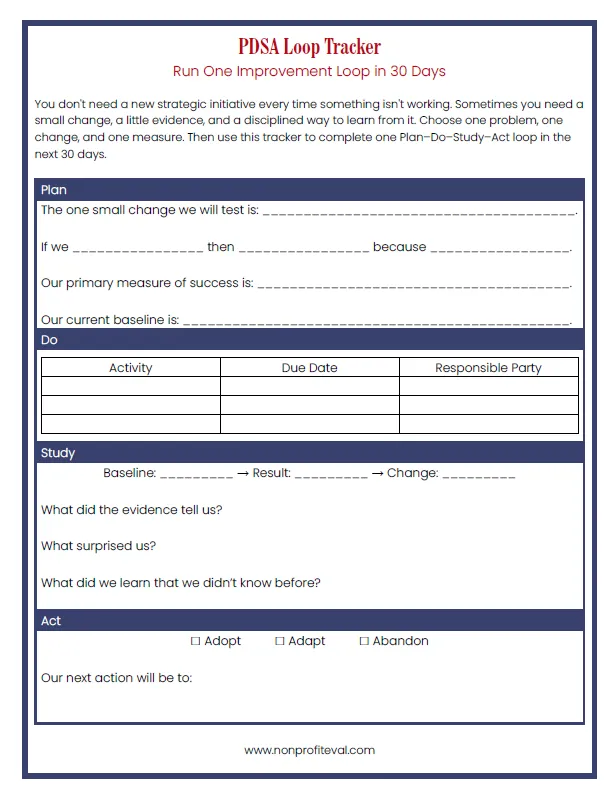
PDSA Loop Tracker: Run One Loop in 30 Days
Continuous improvement doesn’t require launching another major initiative. The PDSA Loop Tracker gives nonprofit leaders a practical structure for testing one small change, studying the evidence, and deciding what to do next—all within 30 days.
Choose one problem, one change, and one measure, then work through a complete Plan–Do–Study–Act cycle. At the end of the month, you’ll have evidence to help you decide whether to adopt the change, adapt it and test again, or abandon it and try something different.
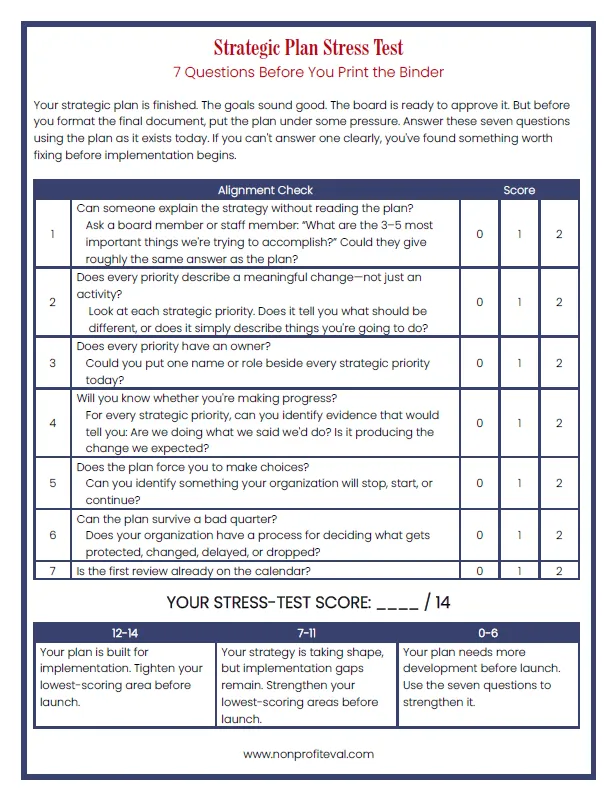
Strategic Plan Stress Test: 7 Questions Before You Print the Binder
Finishing a strategic plan is one thing. Building a plan your organization can actually implement is another. The Strategic Plan Stress Test gives nonprofit leaders seven questions to ask before declaring the planning process complete.
Use the scorecard to test whether your plan has clear priorities, meaningful outcomes, ownership, measures of progress, real strategic choices, adaptability, and a process for ongoing review. In just a few minutes, you’ll identify potential weaknesses that are much easier to fix before the plan reaches the boardroom—or the printer.